1957 Investigation to Find The Truth About The Rumour
Elvis had been accused of a making a hugely unpleasant racial slur. It proved very difficult for anyone to identify when exactly it happened. It transpired that at the time he had never been to Boston where it was alleged he had made the remark. Also he had never been on the TV show where other rumours say he had made the racial slur. Elvis was adamant he had never said such a thing. He was interviewed by Louie Robinson, the Associate Editor of black owned Jet magazine and the outcome was published in the August 1 1957 edition of Jet .
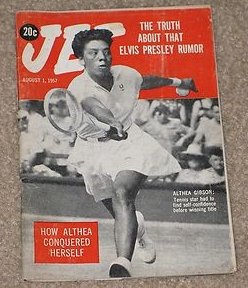
Elvis's response was that he never said what he was accused of and people who know him would know he never said that.
He said that he had always wanted to sing like Bill Kenny of the Ink Spots. Elvis said he had sung That's All Right, Mama because he heard Arthur "Big Boy" Crudup.
Elvis was defended by Dr. W.A. Zuber, African American physician from his home town Tupelo, Mississippi who said he knew him as a kid, how he used to play the guitar and go around with quartets and to meetings for black people. He said "...people around here say he’s one of the nicest boys they ever knew. He just doesn’t impress me as the type of person who would say a thing like that.”.
Los Angeles pianist Dudley Brooks, who is Presley’s accompanist on records and for two of his movies described Presley as “a helluva nice guy,” declared: “he faces everybody as a man ...I never heard of the remark, but even so I can’t imagine Presley saying that, not knowing him the way I do.”
In the interview Elvis is recorded as going on to be quite frank about his contribution to rock music. He said “A lot of people seem to think I started this business”. He went on to say “but rock ’n’ roll was here a long time before I came along". His position on rock music was nobody could sing that kind of music like black people. He concluded "Let’s face it: I can’t sing it like Fats Domino can."
The article concludes with the quote:
- “It’s a stupid rumor. To Elvis, people are people, regardless cf [sic] race, color or creed.”
However, despite the full and frank interview with Jet magazine the rumour persists to this day. This is despite it even being possible to find a quote where a person who claims to be the originator actually confesses that he made it up and even he is surprised at how it took off.
Some Interesting Influences
Elvis had a tendency to tell anyone who would listen about how his style is influenced by rhythm and blues and gospel. In the mid 1950s the kind of music that Elvis was supportive of was still sometimes termed 'race' music and bought by African Americans but not readily encouraged for others. Apparently the records were almost treated as contraband.
Arthur “Big Boy” Crudup
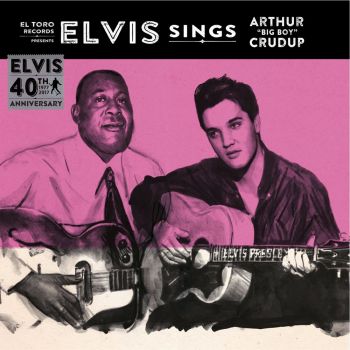
Presley probably didn't particularly endear himself to the mainstream establishment when in June1956 he told a reporter from the Charlotte Observer:
- "Down in Tupelo, Mississippi, I used to hear old Arthur Crudup bang his box the way I do now, and I said if I ever got to the place I could feel all old Arthur felt, I'd be a music man like nobody ever saw."
To the reporter, this may have sounded like he was speaking another language at the time. But to anyone who knows their music history, it was Elvis paying homage to Arthur “Big Boy” Crudup who came before him.
B.B. King
 In the 1950s America was still heavily segregated. Blacks and whites were discouraged from mixing. Records show Elvis would often turn up at segregated all-black functions. Possibly because of his mixed neighbourhood roots as a child he was at ease with people from black backgrounds and it seems they were the same with him.
Elvis attended the otherwise segregated WDIA black radio station's annual fund-raiser for black children at Memphis' Ellis Auditorium in 1956. He is also down on record as saying to B.B. King, whom he performed alongside, 'Thanks, man, for all the early lessons you gave me'. B.B. King actually knew Elvis before he was famous.
Otis Blackwell
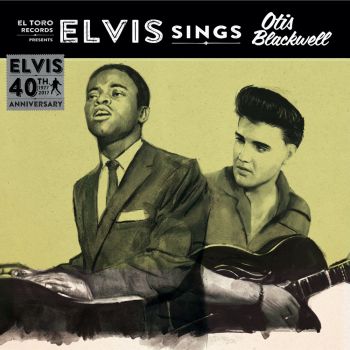
It is said that Elvis had long admired Otis Blackwell. This respect contributed to him selecting three songs written by Otis. "Don't Be Cruel", "All Shook Up" and "Return to Sender". They were all huge successes.
Jet magazine in 1957 said of the association between the two -
- 'Blackwell refuses to disclose his earnings on the songs, but he says: “I got a good deal. I made money, I’m happy.”'
Apparently the two did not ever meet, though Otis was offered a part in an Elvis film. A definite outcome of the relationship was that it certainly was profitable for both parties. Any contribution to a songwriter getting more crossover appeal cannot really be a bad thing.
Rev. William Herbert Brewster
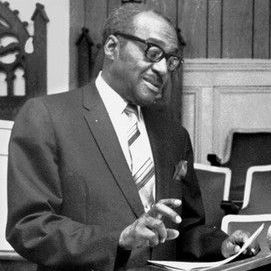
Elvis was always clear about having benefited from attending church services as a child and listening to and joining in with black gospel music. A definitely mentioned church was Rev. Brewster’s church (Rev. W. Herbert Brewster of East Trigg Ave. Baptist Church in Memphis).
Elvis would go on to win three GRAMMY awards in gospel music categories.
A Selection of Pictures
With the Greatest
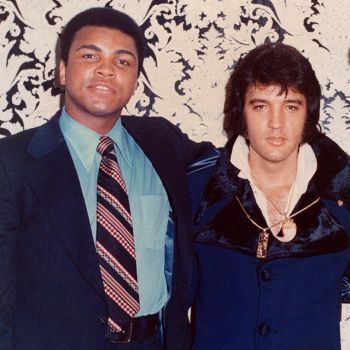
Ali and Elvis struck up a friendship in the 1970s
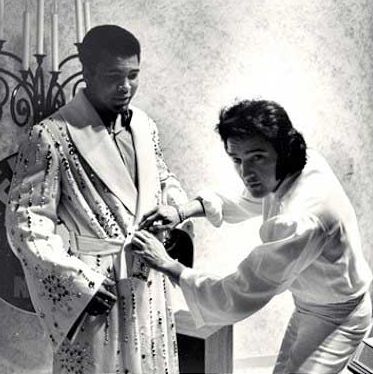
The Robe Elvis Gave Ali
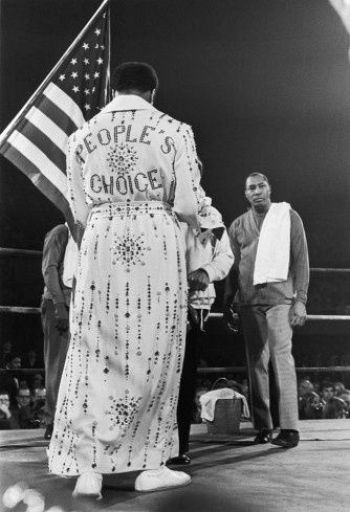
Ali in the robe on fight night
Antoine “Fats” Domino
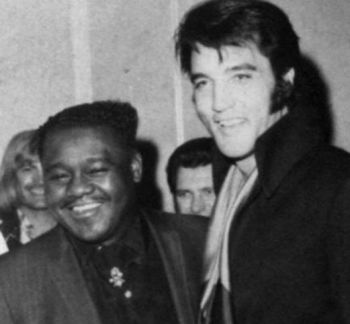
Fats Domino and Elvis 1969
Let’s face it: I can’t sing it like Fats Domino can. Elvis 1957
Billy Ward
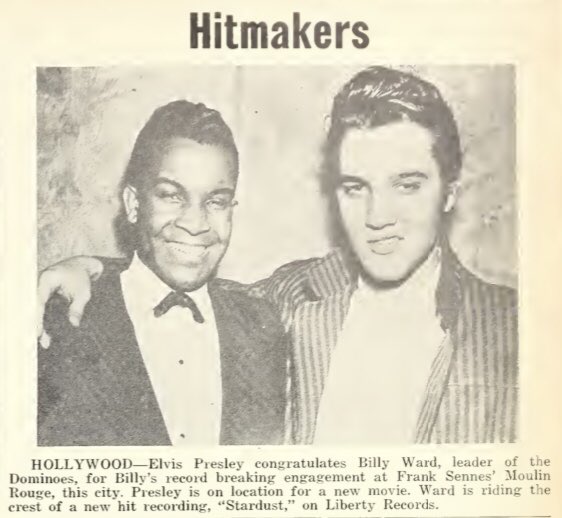
Elvis Congratulates Billy Ward Las Vegas 1956
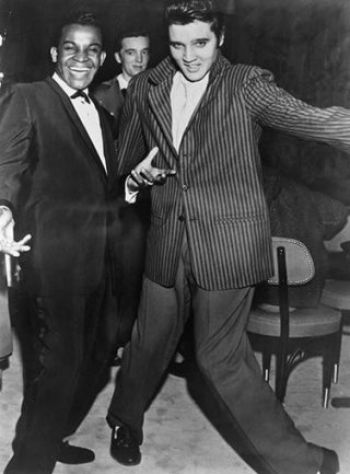
Elvis and Billy Ward Feelin' the Groove Las Vegas 1956
Jackie Wilson
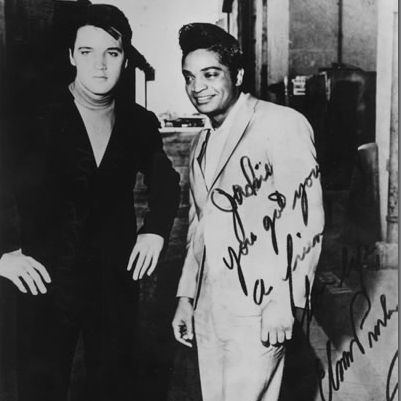
Jackie Wilson and Elvis 1966
signed 'Jackie, you have a friend forever, Elvis Presley'
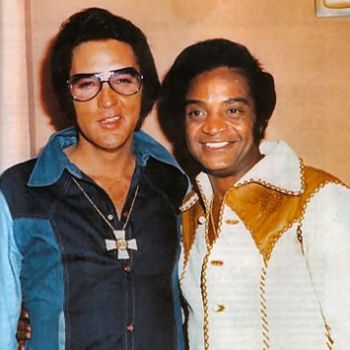
Jackie Wilson and Elvis 1974
Brook Benton
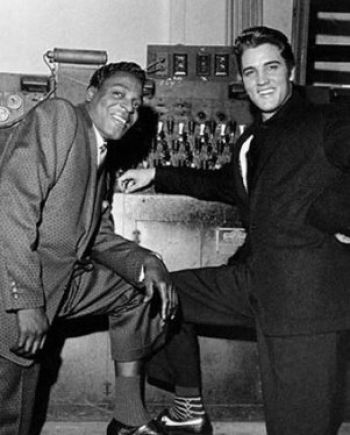
Elvis Presley Backstage with Brook Benton 1957
He was still attending the WDIA Goodwill Review, Memphis.
Seems that country boy just would not be told.
Sammy Davis Jr.
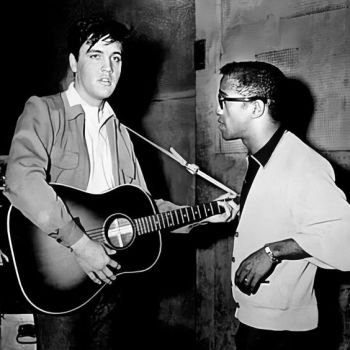
Elvis Presley with Sammy Davis Jr. 1958

Elvis Presley with Sammy Davis Jr. 1970
Young People Ignoring Segregation
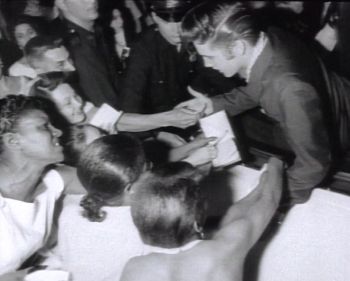
Elvis mobbed by fans on return from touring in 1956
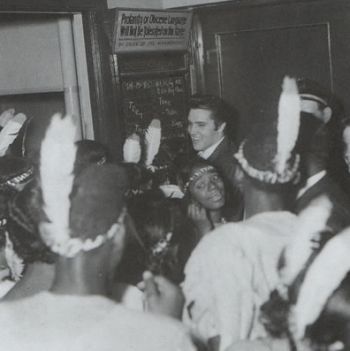
Elvis backstage at WDIA Goodwill Revue, Memphis,1956.

Elvis at Memphis amusement park on East Parkway 1956, during what was designated as ‘colored night.’
Remembering Elvis
Muhammad Ali
Eddie Murphy
Sam Bell
"If you were a child you belonged to that whole neighbourhood"
James Brown
"The world of soul has no colours, it has no barriers"
B.B. King
Knew him before he was big and after he was big.
Ray Charles
Elvis ...caused a lot of the populace to listen to music that normally they wouldn't have listened to...
... he came along at the right time and the girls could swoon over him.
Little Richard
"...He electrified and elevated. I love Elvis"
Fats Domino
"...I think of this man every time I come to my band stand. I play this for the great Elvis Presley."
Estelle Brown
"It was wonderful, he made everything so easy."
Cissy Houston and Myrna Smith
Cissy - "It was wonderful he was wonderful ... a gentleman."
Myrna (3:39) - Elvis was told in Texas you can leave the black girls home. Elvis responded he "...wasn't going to do the Astro Dome unless his girls could be with him...
... he demanded that we be given the star treatment."
Roy Hamilton
He was one of Elvis's biggest early influences.
Darlene Love
Gospel Production Number ('68 Comeback Special)
The 1968 production with the iconic Claude Thompson solo dance interpretation.
The If I Can Dream Song
Rev. Martin Luther King Jr. had been assassinated in April 1968. Bodyguard accounts recall that Elvis was deeply angered and upset by this and later on the assassination of Senator Robert Kennedy.
Elvis recorded If I Can Dream in June 1968. Listening to the words one can notice how it harmonises with MLK's I have a Dream speech.
Elvis's 1968 Comeback Special was to air in December 1968 and was his return to live performance after seven years. His manager planned that he would end the show with a Christmas song to get an obvious Christmas hit. By June 1968 Elvis had other plans.
The details at the web page IF I CAN DREAM" ~ SONG IN THE SPOTLIGHT show the lengths Elvis and Steve Binder went to make sure he ended the historic show with If I Can Dream rather than I'll Be Home For Christmas.
If I Can Dream did not hit the immediate highs that a Christmas song might have but it remains alive and respected to this day. Indeed it is being found by a generation of YouTube influencers who have the luxury of listening to it for their first time in a post segregation world. However, this world is still troubled with pain.
I found a number of influencers filming their experience of hearing the song for the first time. Without fail each one moved me. It is stunning to see a 50 plus years old song still has the effect it was originally meant to have on so many people who were not even born at the time. Rather than link the song I have linked some people hearing the song and commenting on what it did for them. Sometimes a song and a commentary together are even more powerful.
If I Can Dream
"To create a tribute in the name of Martin, that speaks volumes."
"If a person physically put their soul in something and they left it here, I believe that..."
"I'm at a loss for words..."
"...he obviously, within the verses themselves, speaks to a better time eventually..."
"That's his job. You feel what he feels."
I'll stop here. YouTube is vast and there are so many quality reacts to this song. Looks like it has been appreciated by a whole new generation.
Conclusion
Steal -
verb (used with object), stole, sto·len, steal·ing.
To take (the property of another or others) without permission or right, especially secretly or by force:
A pickpocket stole his watch.
to appropriate (ideas, credit, words, etc.) without right or acknowledgment.
The preceding pages are a drop in the ocean of what Elvis would say or do in relation to helping people understand the origins of the music he sold.
By definition a person who steals does not normally
- return to the scene of the alleged thefts;
- tell everyone who they got the items from;
- hang out with the alleged victims and
- end up numbered amongst their friends.
The alleged victims have not said Elvis stole. There was a one sidedness to things. They say he benefited because he could get away with things that they couldn't back then. They have said he opened doors.
Elvis never called himself the King of Rock, the media did. Indeed it is believed he was the first to say he wasn't King. On the wheels of change someone had to open the doors for everyone to have access to beautiful music.
Did Elvis help create a world where anyone can buy and listen to all black music? His contemporaries have already answered. Over to you to make your own decision on facts.
Racist -
noun
A person who believes in racism, the doctrine that one's own racial group is superior or that a particular racial group is inferior to the others.
More influential people than me have already formed a judgement about this.
Many of them have left this plane, but their impact on history lives on. My references all lived through the times when The Man wanted segregation. All of them were/are capable of independent thought. They spoke well of Elvis, from first hand knowledge, and had mutual respect and even close friendships.
They lived through the times when Elvis would defy the rules and go where he liked the people and felt they liked him. They lived through the times when Elvis would find ways to infuriate The Man by helping make frowned upon music mainstream. They lived through the times when Elvis would not comment on current issues but would open doors and speak through music.
They did not see Elvis as a racist, I cannot join anyone in saying they were mistaken.